
AMIRI Maintenance for Jeans, Leather and Knitwear
A caveat belongs at the front: the research behind this guide surfaced no brand-published care manual that covers these materials as a whole. What the house does publish is piece by piece: instructions attached to individual product pages and on the tags, reproduced below, with no wider brand guidance on looking after amiri clothing across seasons of wear. Everything else here is unremarkable material practice, the craft knowledge that applies to any hand-finished denim, any ovine or calf leather, and any heavy cotton jersey. Keep that line in mind: plenty of care writing about this label presents general advice as though the house had issued it. Questions about care usually trail searches for amiri jeans, amiri hoodie and amiri men, and their number climbs once people buy amiri online without touching the piece first. When the label and this article disagree, follow the label.
Taking Seriously the Care Labels Themselves
Read the core product instructions before the first wear rather than after the first accident, because they are unusually restrictive. On core denim there is an explicit special-process warning: shading variation is by design and dye transfer onto lighter surfaces is possible. The designation on that denim is spot-clean only, and washing, bleaching, tumble drying, ironing and dry cleaning are all excluded. Core jersey pieces take the opposite route and specify professional dry cleaning rather than home laundering. Because both instructions clash with normal habits around jeans and sweatshirts, most owners ignore them. Composition matters too, since core denim runs at ninety-two percent cotton with six percent elastomultiester and two percent elastane, and elastane degrades in heat.
- Core denim: spot clean only, no wash, no bleach, no dryer, no iron, no dry cleaning
- Core denim: expect intentional shading variation, and treat dye transfer as possible
- Core jersey: send it to a professional amiri outlet dry cleaner
On Denim: the Distressing Is the Product
Start from this: the visible damage is deliberate design work, not a defect. Hand-distressing comes first and open repair second, and the best-known case is the MX1, with pleated ovine leather set into the abraded areas at knee and thigh. A hot wash, a tumble dryer or an aggressive commercial cleaner all share one effect: they homogenise the surface and strip out exactly what you paid for. On a Shotgun, frayed edges are designed to look blown out and sanded; on a Stack, the long inseam is there to concertina over a sneaker. Neither is a defect, and neither should be tidied up by a tailor working from instinct. Let wear develop through use rather than through laundering: rest a pair for a day between wears and the shape recovers on its own.
How to Clean Hand-Distressed amiri jeans
Spot cleaning means treating the mark and not the garment, and it is slower and duller than any alternative. Start at the outside of a stain and work in with a barely damp cloth and cold water, blotting rather than rubbing. Leather inserts want water kept well away: the two materials dry at different rates, and the join is where the damage shows. Let a pair air-dry flat or over a broad hanger, kept away from radiators or direct sun, since heat bakes in shrinkage and colour loss alike. Odour is usually the real reason people reach for a wash, and it responds better to airing and a distant pass of steam than to soap. Deep indigo will transfer onto pale upholstery and light sneakers, so put a few cautious wears on a new pair before trusting it near either.
Looking After Leather Inserts, Rivets and Studs
Of everything on the garment, hardware and contrast panels come up for attention soonest, and early intervention is far cheaper than a late repair. On genuine pieces the rear leather patches, buttons and rivets are substantial and securely set, so any looseness is a repair signal, not a characteristic. A dried-out leather insert can be fed with a little neutral conditioner applied to the panel alone and buffed off before it migrates onto the denim. Loose threads at a repaired seam should be secured and never pulled, because one tug can open a run through inches of hand-finished work. Bandana and jacquard panels occupy the same structural position that leather occupies elsewhere in the line, so treat a printed panel with equal caution. Studs and crystal settings want checking every few wears, since they are what catches on car seats and chair arms.
Leather Boots, Jackets and Sneaker Uppers
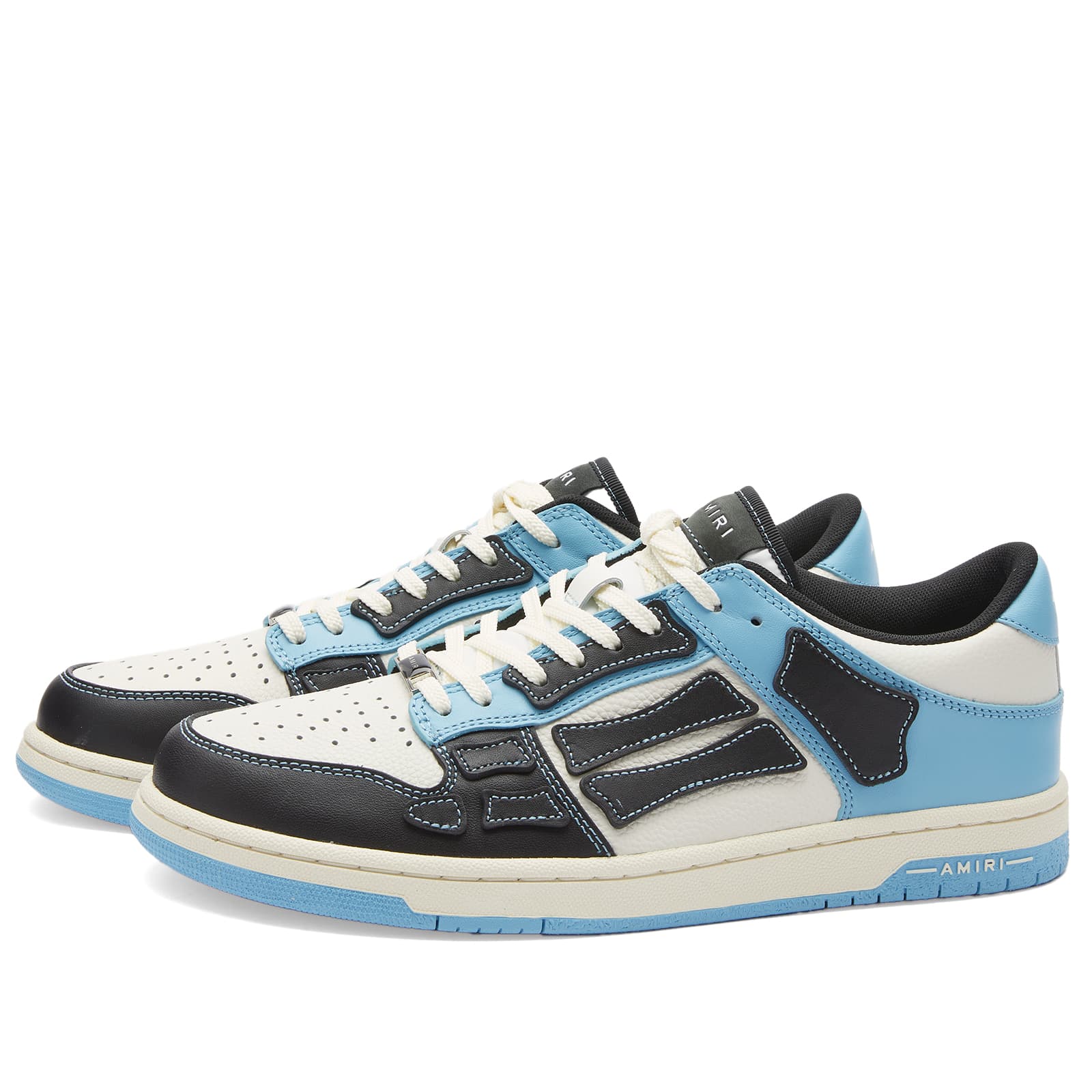
Leather turns up in three distinctly different roles here, and each calls for different treatment. Boots such as the Ryder, observed at $1,090 in leather, $1,190 in suede and $1,290 in a python-embossed finish, take conventional boot care: brush after wear, condition sparingly, use trees. The exception is suede, which wants a brush and an eraser rather than cream, and which should be protected before the first wear instead of rescued after the fact. Leather over a rubber sole is what the Skel-Top Low gives you, which means a damp cloth and a soft brush take care of almost everything a machine wash would ruin. Those bone appliqués are hand-cut and outlined in contrast topstitching, so scrubbing loosens the stitching before it shifts any dirt. Leather of any kind, once wet, should be dried slowly, at room temperature and away from anything warm.
Jersey and Knitwear
Nowhere is the divergence between the tag and normal habits larger than on the hoodies and tees. The instruction on core jersey is professional dry cleaning; the MA Core Logo Hoodie is entirely cotton and made in the United States, which is why heat shrinks and distorts it. Should you launder a jersey piece at home against the tag, the least destructive route available is cold water, garment inside out, gentle cycle, no dryer. Applied graphics, chenille patches and embroidery are the earliest casualties, and what kills them is friction and heat, not soap. A hanger is the wrong choice for drying: a wet heavyweight hoodie will stretch through the shoulders under its own weight, so lay it flat. Fleece and knit both pill with wear, and a comb or fabric shaver used gently restores the surface without thinning it.
Storage, Rotation and Travel
Most avoidable damage happens while things are put away, and fixing it costs nothing. Either hang denim by the waistband on a clip hanger or fold it along existing creases, and keep repaired panels flat rather than bent over a bar. Separate dark from light in the wardrobe: the dye transfer warning on core denim applies just as much to its neighbours on the rail. Air and space are what leather needs: a compressed garment bag holds moisture against the surface and encourages mould in humid climates. Rotate rather than wear one pair daily, as fibres with elastane content need time to recover their shape. Travel works best with rolled jersey, folded denim and footwear in its own bag, with the sole isolated from everything else.
The Short Version, and When to Hand It Over
Everything above is distilled in the table into the shortest usable form, naming the material, the instruction with the most weight behind it, and the worst common error. Wherever the brand’s own tag says something specific, it takes precedence the general practice listed here. None of these are laboratory results and none come from a brand-published care manual, because no such manual was found. They are the careful options, and with hand-finished garments that is usually the right bias.
| Material type | Key instruction | What people get wrong |
|---|---|---|
| Core distressed denim | Spot clean with cold water and dry in air | Machine washing or tumble drying |
| Leather panels set into denim | Condition the panel on its own and keep it dry | Letting the panel soak with the rest |
| Cotton jersey, core line | Professional dry cleaning per the tag | Washing hot and then hanging it wet |
| Smooth leather and suede | Brush and shape; cream on smooth only | Conditioning suede or drying near heat |
| Leather uppers on sneakers | A damp cloth plus a soft brush | Running them through a machine |
There is a point at which doing nothing is the skilled response. Structural damage through a repaired panel, a torn leather insert, a failed seam under a stud field or a stain set into distressed denim all belong with a specialist, and so does anything involving solvent, dye or heat. After-sales service and repairs are offered from the brand, but the terms are narrow: assistance is handled case by case, it applies to products purchased from its own site, and repair fees can apply. If the purchase was secondhand, the answer is a private specialist, and any good denim or leather atelier will quote before working. Less cleaning, more airing, early repair, and no heat anywhere near any of it.

コメント